

Quick Takeaways
Moisture vapor barrier takeaways
- A moisture vapor barrier is a separate resin layer installed over prepared concrete and beneath the decorative coating system to reduce vapor transmission within the product's published limits.
- DFW's variable precipitation and clay-rich soil regions support a proactive risk-management choice, but they do not prove that every property or slab has the same moisture condition.
- MVB is not a substitute for sound concrete, mechanical preparation, crack repair, or fixing bulk-water sources, and qualifying warranty coverage remains subject to written conditions and exclusions.
The Layer Below The Floor
What a moisture vapor barrier actually does
Concrete looks solid, but its pores can carry moisture as vapor toward the coating bond. The American Concrete Institute’s floor-and-slab guidance treats moisture protection as an important consideration beneath moisture-sensitive or impermeable floor finishes.
Ace’s CFS-CTR Moisture Vapor Barrier is a two-component epoxy layer installed directly over properly prepared concrete. Its job is to reduce vapor transmission before that moisture reaches the decorative system above. It is not mixed into the flakes or topcoat, and it is not a clear sealer added after the floor is finished. It is a separate, continuous layer with its own preparation, coverage, application-condition, and recoat requirements.
MVB addresses a risk below the visible floor. Once the base coat, flake, and topcoat are installed, the slab-to-coating interface is hidden, so mitigation is most practical during the original installation.
Where MVB belongs
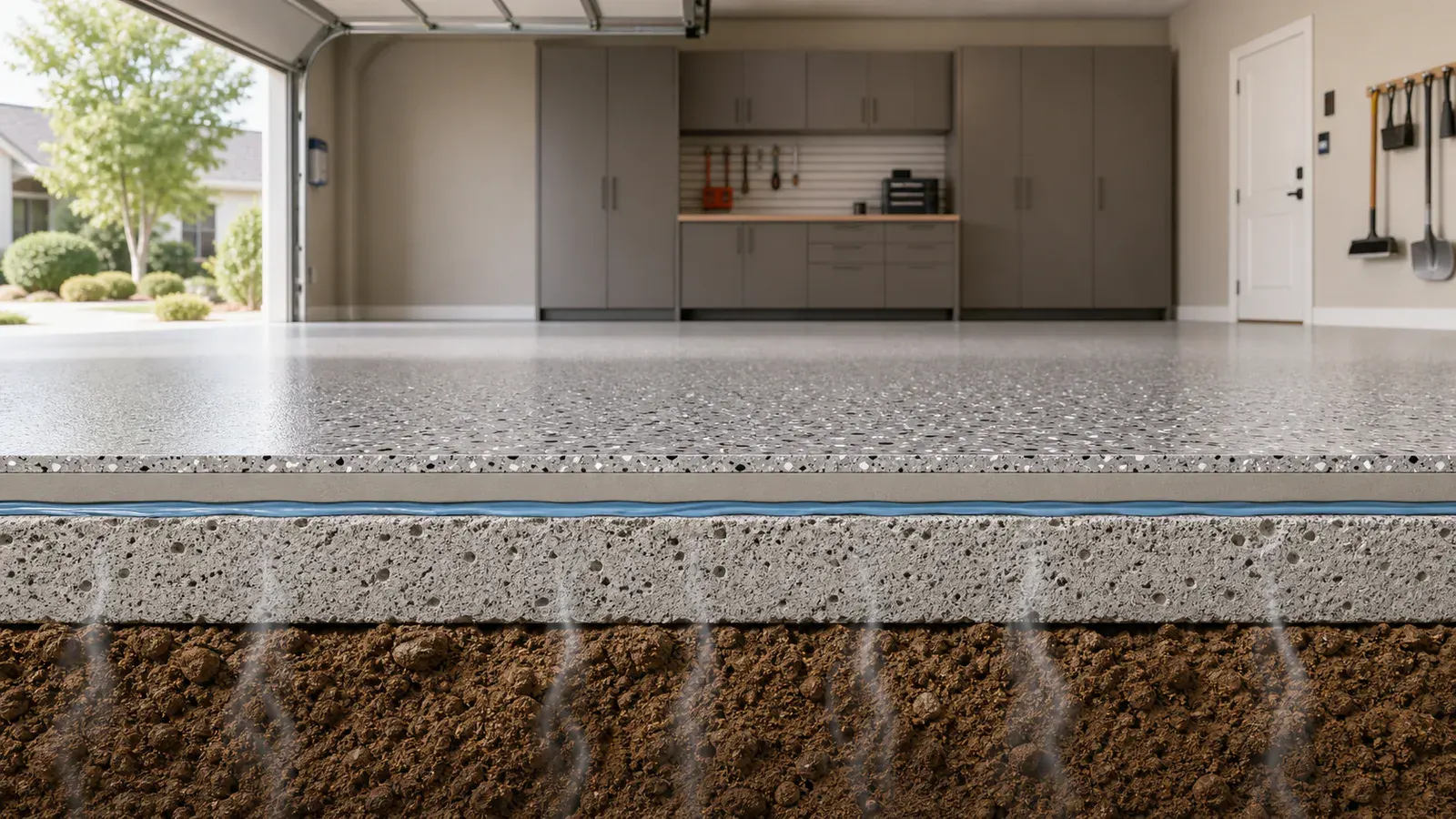
- 1. Soil and below-slab conditions can supply changing moisture below the garage.
- 2. The concrete slab is porous and must be sound, prepared, and suitable for coating.
- 3. CFS-CTR MVB is installed as the first coating layer when selected.
- 4. CFS-CTR Polyurea forms the pigmented base that receives the flake broadcast.
- 5. Torginol flake and CFS-2C Polyaspartic create the decorative surface and clear wear layer.
Why DFW Context Matters
Conditions below a garage slab do not stay frozen in time
The National Weather Service’s DFW climate narrative describes hot summers, considerable year-to-year precipitation variation, wetter spring and fall periods, and rainfall often tied to thunderstorms. The moisture environment around North Texas homes can therefore change across seasons and years.
The USDA Natural Resources Conservation Service’s Texas soil map also documents clay-rich shrink-swell soils in the Blackland Prairie and Grand Prairie. DFW spans multiple soil regions, so the map is context—not a property-specific diagnosis. Drainage, construction, cracks, and below-slab details differ by home.
That variability is the reason for a proactive recommendation. Ace is not claiming that Texas clay “pushes” every coating off a floor, or that every slab has an active moisture problem. The point is that upward vapor is a known, hidden pathway, while the conditions that influence it can change long after the decorative floor is installed.
Ace’s Recommendation
Why Ace does not use a test threshold as the sales gate
Ace does not perform routine moisture testing and does not tell homeowners that MVB becomes available only after a reading crosses a certain number. Instead, Ace recommends CFS-CTR MVB as a proactive option for DFW garage floors because below-slab conditions can vary and the added layer is most useful before the decorative system is built.
Industry tests still have professional uses; the ICRI moisture-mitigation guide covers testing, interpretation, and mitigation. Ace’s residential offering simply does not use one reading as a yes-or-no sales trigger. The proposal identifies MVB, while current product instructions still control slab and installation suitability.
Reduce a hidden risk
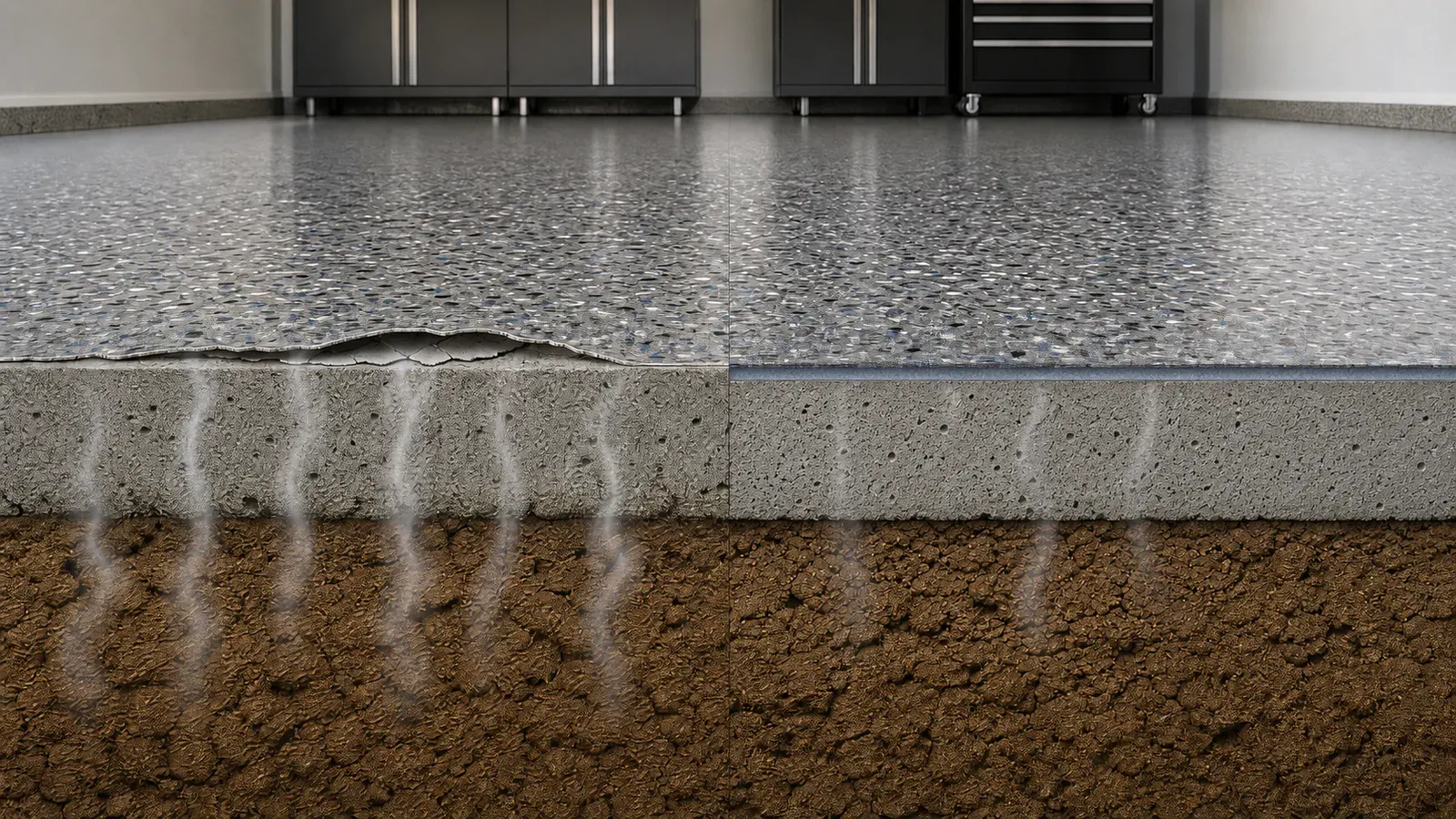
MVB adds a purpose-built layer between porous concrete and the decorative coating instead of asking the finish coat to manage vapor from below.
Define the scope
The signed proposal can name the exact mitigation layer, so homeowners can compare systems instead of assuming every quote includes the same protection.
Keep limits clear
A proactive recommendation does not turn MVB into a guarantee. Product requirements, slab suitability, application quality, and written exclusions continue to matter.
A System Layer, Not An Additive
How MVB fits into Ace’s garage floor process
Ace first documents cracks, pits, spalls, existing coatings, contamination, and damp areas. The concrete is ground to ICRI CSP 3; coating-removal tooling is used first when needed. Dust is removed, cracks are opened with a crack-chase blade, epoxy filler is installed, and repairs are ground flush.
When included, CFS-CTR MVB is the first coating over that prepared surface. The crew follows current requirements for mixing, coverage, application conditions, recoat timing, and water protection. Ace then installs the pigmented CFS-CTR Polyurea base, broadcasts Torginol polymer flake to refusal, scrapes it, and seals the floor with CFS-2C Polyaspartic. Aluminum oxide can add surface texture.
This is why the barrier cannot compensate for skipped preparation or careless application. Learn more about Ace’s mechanical preparation approach, the layers in a full-flake garage floor system, and the roles of epoxy, polyurea, and polyaspartic.
What Ace documents before coating
- Visible condition: cracks, pits, spalls, old coatings, contamination, and visibly damp areas.
- Planned repairs: what will be opened, filled, removed, or ground flush.
- Selected layers: whether CFS-CTR MVB is included before the decorative system.
- Product controls: the current instructions and site conditions that govern application.
- Written expectations: exclusions, return-to-service guidance, and warranty terms in the signed scope.
Benefits And Boundaries
What MVB helps with—and what it does not fix
Moisture mitigation is valuable when its job is described accurately. It controls vapor transmission through a qualifying slab within the product’s limits. It does not convert a garage into a waterproof structure or erase unrelated slab and installation risks.
What the added layer can do
- Reduce water-vapor transmission through prepared concrete within published system limits.
- Address one recognized cause of bond stress before the decorative floor is installed.
- Create a named, documented layer that can be compared across contractor proposals.
- Support qualifying moisture-warranty coverage when every written condition is met.
What it cannot replace
- Repairing plumbing leaks, flooding, wall or edge seepage, standing water, or irrigation intrusion.
- Correcting hydrostatic or osmotic conditions, structural defects, cracks, joints, settlement, or slab movement.
- Removing contaminants, weak concrete, old coatings, or other bond breakers through proper preparation.
- Following the current product instructions for coverage, application conditions, recoat timing, and cure.
Ace’s limited lifetime moisture warranty is conditional. The approved MVB must be part of the original signed system, Ace must document the required slab evaluation, the slab and installation must meet the system requirements, and the covered adhesion failure must be caused solely by vapor transmission through the slab within published limits. Cracks, joints, leaks, flooding, hydrostatic or osmotic conditions, structural defects, edge or wall seepage, standing water, and other listed causes are excluded. Read the complete written warranty; it controls over any summary.
Compare The Written Scope
Questions to ask before choosing a floor system
“Moisture protection” is not the same as a named product and application plan. Confirm that the barrier is included, where it belongs, how the slab will be prepared, which requirements apply, and what the warranty excludes.
The quote comparison guide covers other scope differences. For an existing lifted area, the hot-tire pickup guide explains why moisture is only one variable.
Seven useful questions
- 1. Is MVB included in the signed proposal, or only discussed as an option?
- 2. What exact product is installed, and where does it sit in the system?
- 3. How will the concrete be profiled, cleaned, and repaired first?
- 4. What site conditions would prevent application that day?
- 5. How are edges, cracks, joints, penetrations, and visible damp areas handled?
- 6. Which moisture sources and failure modes remain excluded?
- 7. What written warranty applies to the complete installed system?
Ace Evaluation And Next Step
Make the MVB choice before the floor is built
Ace’s pre-work evaluation is visual and condition-based. Ace documents cracks, pits, spalls, existing coatings, contamination, and visible dampness so those conditions can be addressed in the preparation and written scope. Ace does not perform routine moisture, adhesion, or laboratory testing. If CFS-CTR MVB is selected, it should appear on the original signed proposal rather than being assumed from a general phrase such as “epoxy floor.”
Review Ace’s DFW garage floor coating service, browse completed floor coating projects, or use the floor coating estimator for early planning. For a written plan for your slab and selected layers, request an on-site quote.
Primary technical references
The CFS references identify Ace’s owner-confirmed MVB product and application requirements. The industry, soil, and climate sources provide general context; none diagnoses a specific property or promises a result outside the installed product and written warranty.
- Concrete Floor Solutions: CFS-CTR Series Moisture Vapor Barrier, plus the current technical data and installation instructions supplied to Ace
- American Concrete Institute: Guide for Concrete Floor and Slab Construction excerpt
- ICRI 710.3-2022: Guide for the Mitigation of Moisture in Concrete Floor Slabs
- USDA NRCS: General Soil Map of Texas
- National Weather Service: Dallas/Fort Worth Climate Narrative
- Ace Garage Pros: current written floor and qualifying MVB warranty terms