
Quick Takeaways
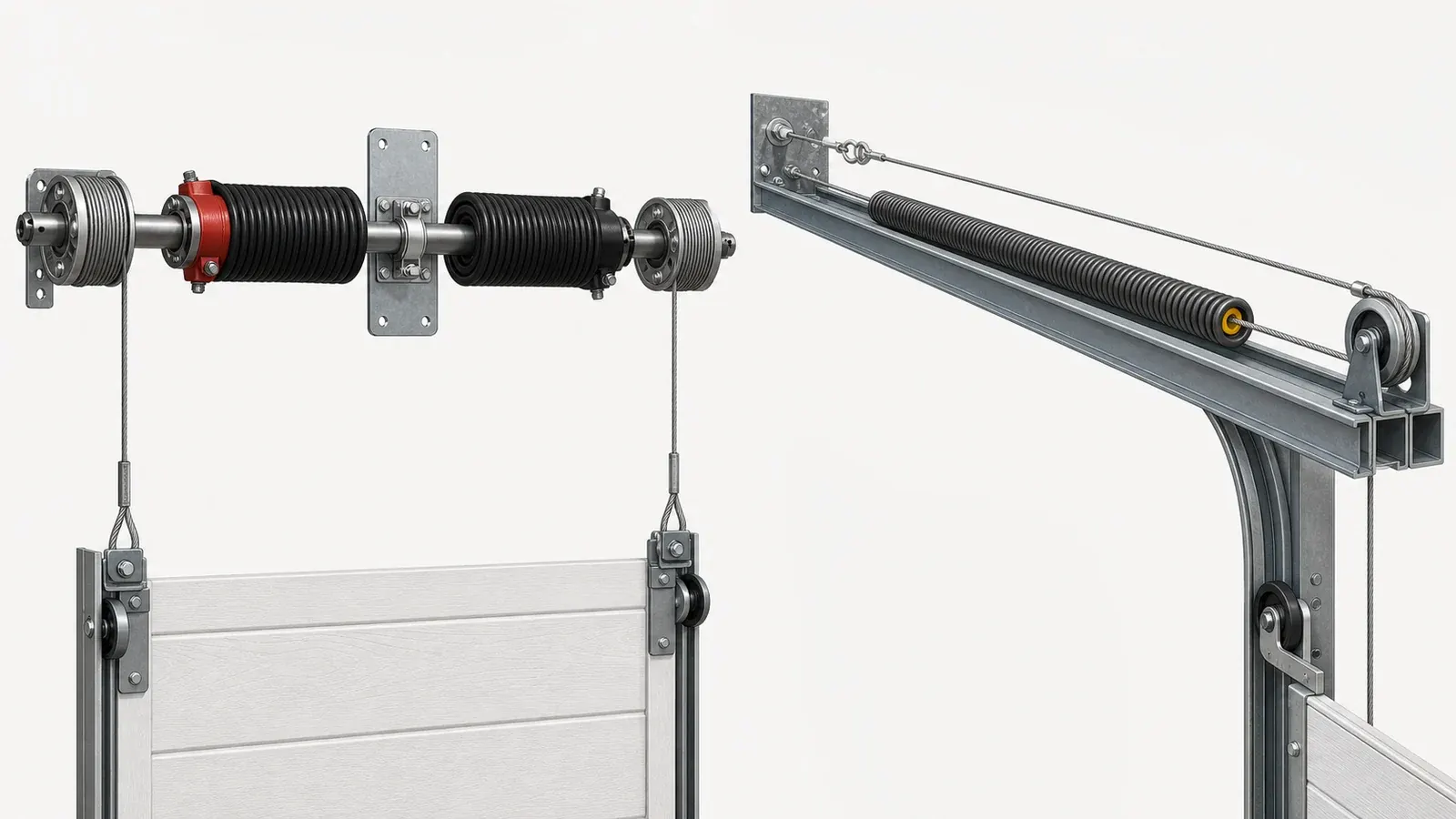
- Torsion systems commonly use springs on a shaft above the door with cable drums; extension systems commonly stretch alongside the horizontal tracks and need the correct pulley, cable, and containment arrangement.
- Springs wear through repeated cycles, but door weight, sizing, balance, corrosion, environment, alignment, damage, prior work, and use all affect service life.
- A broken spring can leave the door dangerously heavy. Springs, cables, drums, bottom brackets, and tension hardware are not DIY service items.
Torsion and Extension Systems
| System | Typical arrangement | Important service context |
|---|---|---|
| Torsion | One or more springs wind around a shaft above the door; drums and lift cables work at the ends. | Door weight, spring dimensions, wind, shaft, drums, cables, track, and balance must be evaluated as one compatible system. |
| Extension | A matched spring arrangement stretches near the horizontal tracks and works through pulleys and cables. | Correct containment safety cables, pulleys, anchors, lift cables, track geometry, and matched parts are important to the installed design. |
Why Springs Wear or Break
Repeated Cycles
Opening and closing flexes the spring. Published cycle ratings are engineering references, not a calendar guarantee for every installed door.
Door Weight and Balance
A spring must be matched to the actual door and hardware. Added weight, wrong sizing, or imbalance can change system loading.
Corrosion and Environment
Humidity, condensation, chemicals, and surface corrosion can affect metal condition, but appearance alone does not determine remaining life.
Alignment, Impact and Prior Work
Binding tracks, damaged hardware, loose mounts, impact, or incompatible replacement parts can add stress or create other failure paths.
Common Failure Signs
- A visible gap in a torsion spring or a visibly separated extension spring.
- A loud bang followed by a door that will not lift normally.
- A door that feels unusually heavy, travels crooked, rises only a short distance, or drops.
- Loose, displaced, or frayed cables; damaged drums, pulleys, anchors, or bottom fixtures.
- An opener that strains because the counterbalance system is no longer carrying the intended load.
What Professional Spring Service Evaluates
Ace identifies the installed spring arrangement, door size and construction, balance, cables, drums or pulleys, bearings, tracks, attachment points, opener behavior, and visible damage before quoting compatible work.
Do not loosen, clamp, cut, wind, unwind, or move a spring, cable, drum, pulley, or bottom bracket. Keep people and vehicles clear of an unsafe door and request service.